

Mileage Storage Locations in the Vehicle
Where does a modern vehicle store the mileage? All storage locations explained. Why complete synchronization is crucial.
Where Does a Modern Vehicle Store the Mileage?
A common question customers ask us: "Where exactly is the mileage stored in my car?" The answer surprises many: Not in a single place — but in several simultaneously.
Modern vehicles are complex electronic networks. Numerous control units communicate with each other via the CAN bus (Controller Area Network). Many of these control units store the mileage for safety, diagnostics, and plausibility reasons:
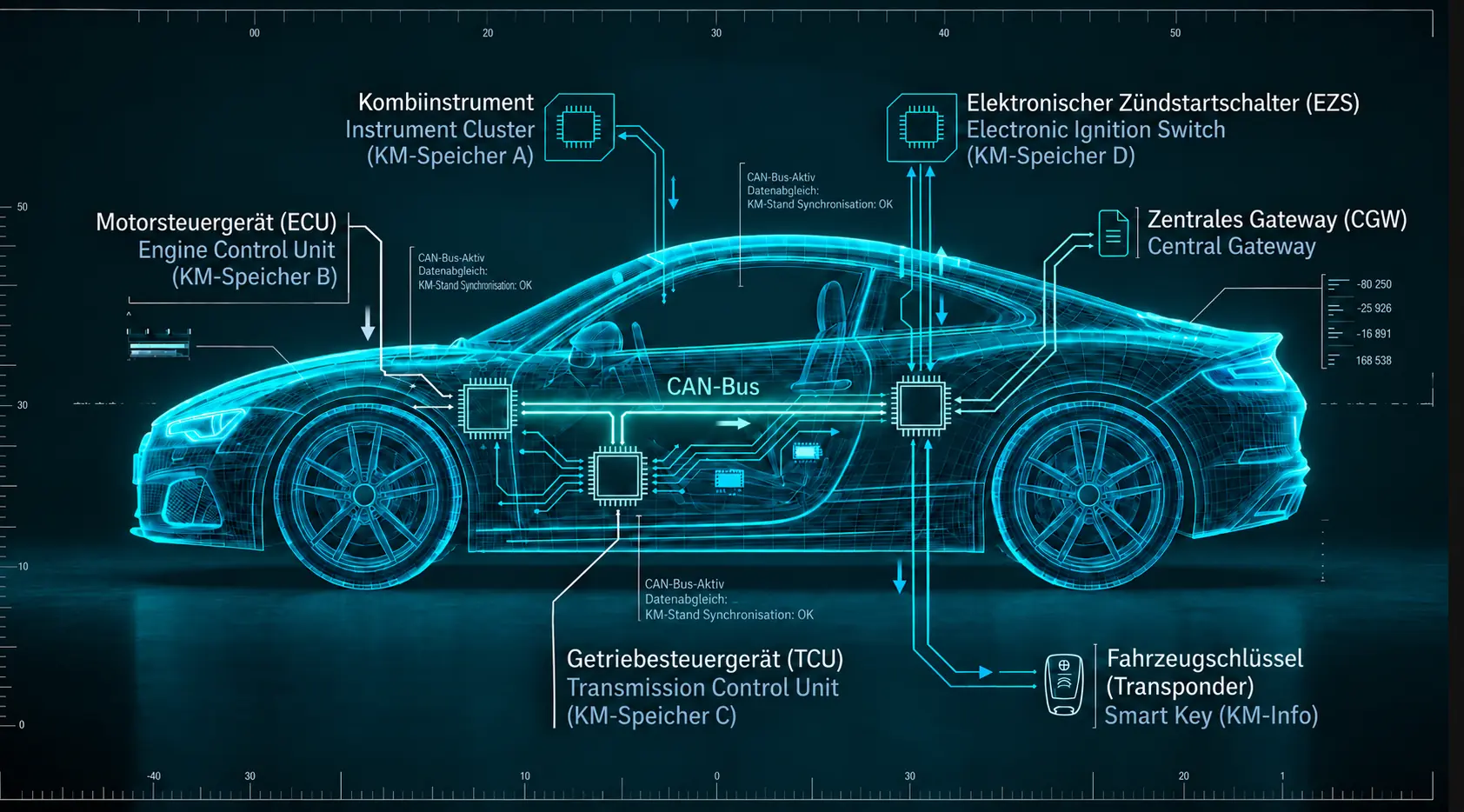
The Most Important Mileage Storage Locations
1. Instrument Cluster (Kombiinstrument)
This is the most visible storage location — the speedometer display itself. The mileage number you see on your dashboard comes from the instrument cluster. But it is by no means the only place.
2. Engine Control Unit (ECU)
The engine control unit stores the mileage for service calculations and engine monitoring. Replacing a tachometer cluster without adapting the ECU creates inconsistencies that can be noticed during vehicle history checks (e.g. by TÜV, DEKRA, Carfax, etc.).
3. Gateway Control Unit
The gateway is the central communication unit between all vehicle networks. It manages and logs information between different CAN bus areas, including the mileage.
4. Electronic Immobilizer (EWS / Immobiliser)
Particularly in BMW vehicles, the immobilizer (EWS) is known as a separate storage location for the mileage. This must be adjusted separately during speedometer calibration.
5. Other Control Units (Model-dependent)
Depending on the vehicle manufacturer and model, other control units may also store the mileage:
- Transmission Control Unit (TCU)
- Airbag Control Unit (ACU/SRS)
- Ignition Lock / EIS (Mercedes) — Electronic Ignition Switch
- Assyst / Maintenance Calculator (Mercedes)
- Body Control Module (BCM)
- Vehicle Keys (programmed transponders in BMW keys)
Why is Complete Synchronization So Important?
If, after a cluster replacement or repair, only the instrument cluster (the visible display) is set to the correct mileage while the other control units still contain the old (incorrect) value, inconsistencies arise.
These inconsistencies can:
- Be detected during the main inspection (TÜV/HU) — modern testing equipment reads out all relevant control units.
- Be noticed during a vehicle sale via vehicle history services (e.g., DEKRA check, vehicle evaluation).
- Cause vehicle electronics issues (e.g., incorrect service warnings, driver assistance errors).
Our Solution: Complete Synchronization of All Storage Locations
At Tacho Frankfurt, we adjust all relevant storage locations as a matter of principle — not just the visible display. This is the crucial quality difference between our professional expert work and many cheap offers that only adjust the instrument cluster.
Only a complete synchronization of all storage locations delivers a truly consistent, verifiable, and permanent result.
Questions? We Are Happy to Help!
Tacho Frankfurt
Schultheißenweg 105A, 60489 Frankfurt am Main (Rödelheim)
☎ +49 176 / 20 611 662 | info@tacho-frankfurt.de
→ Back to Speedometer Calibration Information and FAQ
→ Get in Touch